
Whether you’re renovating or building new, thinking about how to keep your home cooler in summer is especially important in Australia, where temperatures can soar for months at a time. At Style Curator, we’re big believers in adopting passive design principles and using a considered mix of cooling solutions, so you have maximum control over comfort and energy efficiency — without relying on air conditioning alone.
Which brings us to a reader question we recently got: ‘Are ceiling fans in living rooms out of style?’ Good question because if you scroll through interior design inspiration online, you’ll notice many beautifully styled living rooms with clean, uncluttered ceilings, statement lighting and not a ceiling fan in sight! The short answer? No, ceiling fans aren’t out of style. But poorly chosen ceiling fans absolutely are!
In Australian homes especially, where warm weather often stretches well beyond summer, ceiling fans remain one of the most practical and energy-efficient ways to improve comfort. The key is choosing a fan that complements the design of your living room, rather than detracting from it. Here are our tips to do just that.
Related article: Smart home upgrading: How to build a future-ready abode
Related article: Designing a family-friendly home: Home inclusions for families
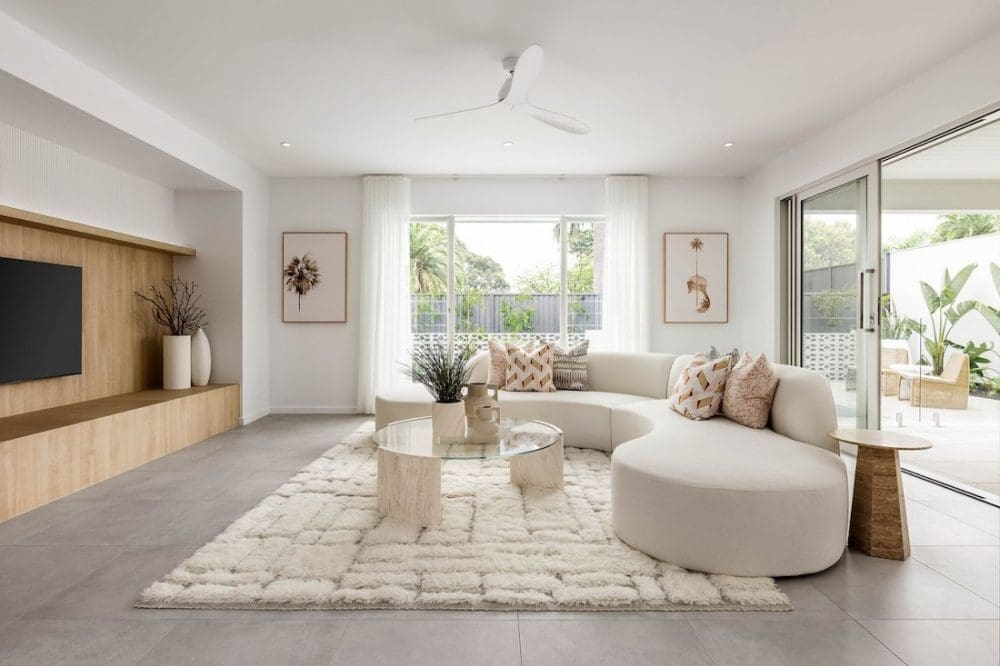
Why ceiling fans still make sense in Australian living rooms
From a design perspective, ceiling fans sometimes get a bad reputation but functionally, they’re hard to beat! In Australia and many other tropical/hotter climates, a room without air moment is simply unliveable.
Unlike air conditioners that cool the air, ceiling fans create a wind-chill effect that cools the person. Fans can make a room feel up to 4–6°C cooler, which is often enough to create a comfortable environment and avoid the need to turn on the air conditioner. This is especially true in the evenings, which can significantly reduce energy use and running costs.
Best of all, ceiling fans work while windows and doors are open, so you can maintain airflow and comfort without sealing your home or relying solely on air conditioning.
It’s all these benefits that only ceiling fans offer that make us say yes, they are still a good design decision. Just make sure you pick fans that feel like an intentional design choice, rather than a practical afterthought.
What makes a ceiling fan look dated?
In our experience, when people say ceiling fans are ‘out of style’, what they’re reacting to are older fan designs that haven’t aged well.
A ceiling fan is more likely to look dated if it has one or more of the following features:
- frosted dome light kits (often referred to as ‘oyster lights’ or ‘boob lights’), which cast harsh, unflattering light
- bulky motor housings that hang low and visually weigh down the room
- high-gloss finishes, faux timber blades or brass detailing typical of 1990s interiors
- overly ornate blade arms that clash with modern, streamlined spaces.
If a fan draws attention to itself for the wrong reasons, it can undermine even the most thoughtfully designed living room.
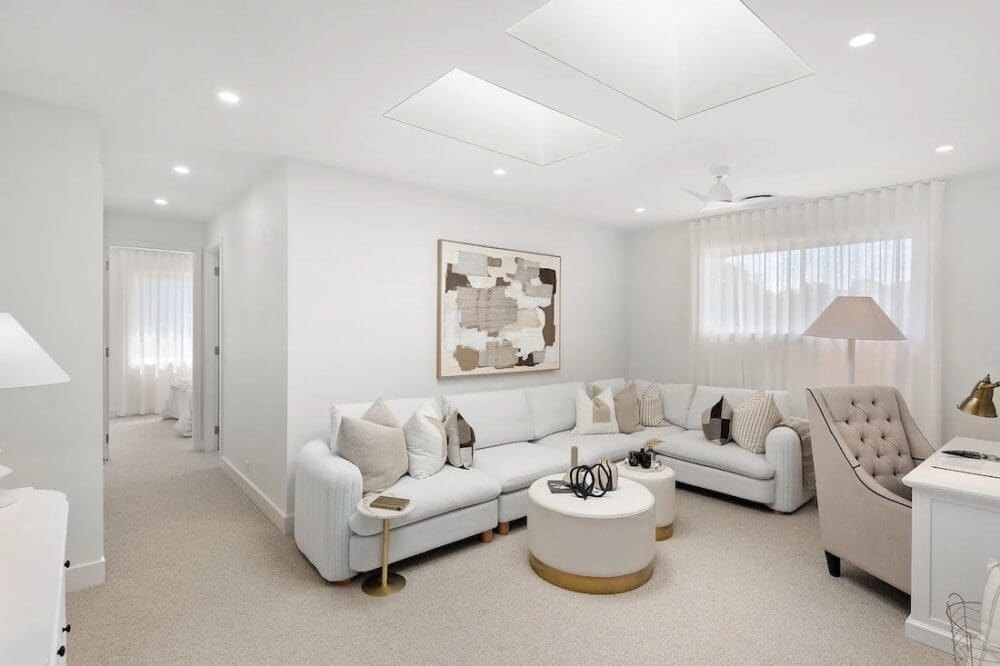
How to choose a ceiling fan that suits your living room
So now that we’ve covered why ceiling fans are still a good design choice and what not to do, let’s discuss how to choose a ceiling fan that will complement your space. When selecting a new ceiling fan, it helps to think of it as hardware, much like tapware or door handles — functional, but visually important.
Choose the right design approach
There are two main ways to integrate a ceiling fan into a living room.
The subtle approach
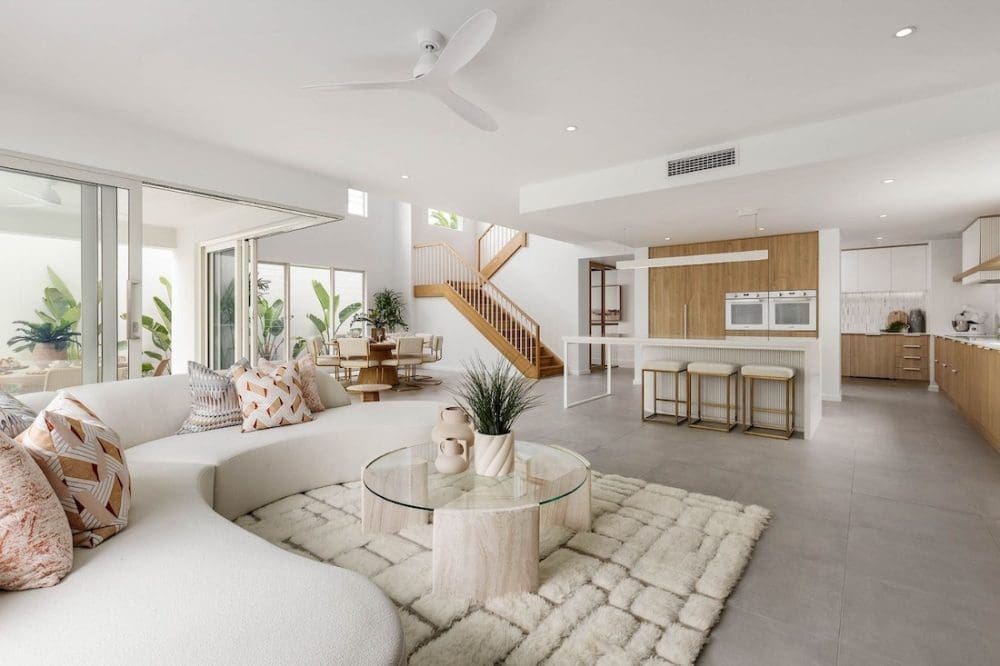
For standard Australian ceiling heights (around 2.4 metres), a low-profile or flush-mount fan in a matte white or soft neutral finish can visually blend into the ceiling. This keeps the focus on furniture, lighting and finishes (take a look at the image above for inspo).
The statement approach
In rooms with higher ceilings or strong architectural features, a ceiling fan can become a design feature in its own right. Matte black fans or fans with real timber blades can add warmth and contrast, particularly in contemporary, coastal or modern farmhouse interiors.
As a general rule, fewer blades look more modern. Three-blade fans tend to feel lighter and more contemporary than traditional five-blade designs.
Get the ceiling fan size right for your space
Scale matters just as much as style. A fan that’s too small can look cheap, while one that’s too large can overwhelm the room.
As a general guide:
- small living areas (up to ~13 m²): 42–48 inch fan / 107-122cm fan
- standard living rooms (up to ~21 m²): 52 inch fan / 132cm fan
- large or open-plan spaces: 62–72 inch / 157-183cm fans provide quieter, more even airflow.
Tip: larger fans tend to feel more refined in bigger rooms because they move air more slowly and quietly, creating a gentle, comfortable breeze.
Style fixes if you can’t replace your ceiling fan
If you’re renting or not ready to replace an existing fan, there are still ways to improve how it looks.
How to improve the look of a dated fan without replacing:
- remove dated light kits where possible and rely on floor lamps, table lamps and wall lighting for better ambience
- update the finish by spray-painting blades in matte black or flat white taking care to apply paint evenly so the fan remains balanced
- flip reversible blades many older fans have a simpler finish on the reverse side (renter friendly).
These small changes to minimise the size or refresh the look can make a surprising difference.
When replacing a ceiling fan is worth it
Sometimes, replacement is the better option. Consider upgrading if the fan wobbles, hums or rattles because modern DC-motor fans are significantly quieter and more energy-efficient.
It’s also worth replacing older combined light-and-fan designs where the lighting is poor and can’t be improved. Newer models offer better quality, energy-efficient lighting, with far more control over brightness and colour temperature. And of course, if the style is firmly stuck in the ’90s and can’t be refreshed with a coat of paint, it may be time to move on.
Today’s ceiling fans are far removed from older designs and can work beautifully within contemporary interiors when chosen carefully.
We hope this guide has convinced you that fans are still a good idea, and given you tips on how to choose one well. Even if you’re not fully convinced, we suggest allowing for a fan in your electrical plan. That way if you move in and realise a fan really would improve the comfort of your home, the wire is already in the ceiling ready to go.